 English
 Español
  Português
  русский
  Français
  日本語
日本語  Deutsch
  tiếng Việt
  Italiano
  Nederlands
  ภาษาไทย
  Polski
  한국어
한국어  Svenska
  magyar
  Malay
Malay  বাংলা ভাষার
  Dansk
Dansk  Suomi
Suomi  हिन्दी
  Pilipino
  Türkçe
  Gaeilge
  العربية
  Indonesia
  Norsk
Norsk  تمل
تمل  český
český  ελληνικά
  український
  Javanese
  فارسی
فارسی  தமிழ்
தமிழ்  తెలుగు
  नेपाली
  Burmese
  български
  ລາວ
ລາວ  Latine
  Қазақша
  Euskal
  Azərbaycan
  Slovenský jazyk
  Македонски
  Lietuvos
  Eesti Keel
  Română
  Slovenski

Call Us
+86-15219932883
Email Us
sophia@lightdailt.com

What Distinguishes Three-Circuit Track Lighting from Others?
Walk into a high-end retail store, and you will notice something subtle but powerful: the lighting is not uniform. Some fixtures highlight the merchandise with bright, focused beams, while others provide a softer ambient glow. In a museum, the lighting changes throughout the day, shifting from a warm, inviting tone to a cooler, more neutral light depending on the exhibit. In a modern office, the lighting adapts to the time of day and the tasks being performed. Behind these sophisticated lighting schemes is a technology that is often overlooked but essential: three-circuit Track Lighting. Unlike standard single-circuit track systems, which control all fixtures on a single circuit, three-circuit track lighting allows multiple circuits to be integrated into a single track profile, enabling independent control of different groups of fixtures.
The question of what distinguishes three-circuit Track Lighting from other types is fundamentally a question of control. A single-circuit track provides one power feed, and all fixtures on that track are controlled together. A two-circuit track provides two separate circuits, allowing two groups of fixtures to be controlled independently. A three-circuit track provides three separate circuits, enabling three independent groups of fixtures. This increased control enables more sophisticated lighting designs, better energy management, and greater flexibility in adapting the lighting to different uses. This article will examine the technical distinctions of three-circuit Track Lighting, including its construction, wiring, control options, and applications. We will also provide detailed specifications for our Track Lighting products from our factory at Zhongshan Dadi Lighting Technology Co., Ltd.
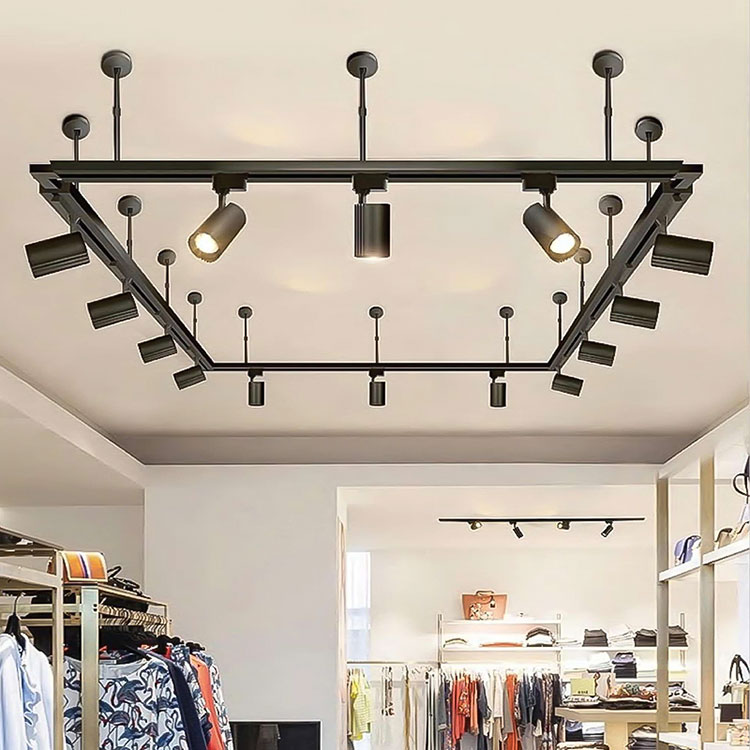
Table of Contents
- 1. What Is Track Lighting and Why Does Circuit Count Matter?
- 2. How Is Three-Circuit Track Lighting Constructed?
- 3. What Control Options Does Three-Circuit Track Lighting Enable?
- 4. How Does Three-Circuit Track Lighting Compare to Single and Two-Circuit Systems?
- 5. What Applications Benefit Most from Three-Circuit Track Lighting?
- 6. What Specifications Define a High-Quality Three-Circuit Track Lighting System?
- 7. Frequently Asked Questions (FAQ)
- 8. Conclusion
1. What Is Track Lighting and Why Does Circuit Count Matter?
Track Lighting is a flexible lighting system that consists of a continuous track, usually mounted on a ceiling or wall, and a series of individual light fixtures that can be attached to the track at any point. The track provides both mechanical support and electrical power to the fixtures. The key advantage of Track Lighting is its flexibility. Fixtures can be added, removed, or repositioned without rewiring. The direction and angle of each fixture can be adjusted independently. This makes Track Lighting ideal for applications where the lighting needs may change over time, such as retail displays, art galleries, and exhibition spaces.
The circuit count of a Track Lighting system determines how many independent groups of fixtures can be controlled. A single-circuit track has one power feed, and all fixtures on the track are controlled together. A two-circuit track has two power feeds, allowing two independent groups. A three-circuit track has three power feeds, allowing three independent groups. The ability to control multiple circuits independently is what distinguishes three-circuit Track Lighting from simpler systems. It enables lighting designers to create layered lighting schemes, where different fixtures serve different functions and can be controlled separately. The table below summarizes the circuit configurations and their control capabilities.
| Circuit Configuration | Number of Circuits | Independent Control Groups | Typical Application |
| Single-Circuit | 1 | 1 | Residential, simple retail |
| Two-Circuit | 2 | 2 | Retail, galleries, offices |
| Three-Circuit | 3 | 3 | High-end retail, museums, architectural |
At Zhongshan Dadi Lighting Technology Co., Ltd., our factory manufactures Track Lighting systems in single-circuit, two-circuit, and three-circuit configurations. We work with lighting designers, architects, and contractors to select the right configuration for each project. Our three-circuit Track Lighting systems are designed for applications where independent control of multiple fixture groups is essential.
2. How Is Three-Circuit Track Lighting Constructed?
The construction of a three-circuit Track Lighting system is more complex than that of a single-circuit system. The track profile contains three separate conductor bars, each insulated from the others. The conductors are typically made from copper or aluminum, and they are housed within an extruded aluminum or plastic profile. The profile is designed to allow fixtures to be attached at any point along the track while maintaining electrical contact with the appropriate circuit. The three circuits are typically arranged in a specific pattern within the track profile to ensure that the fixture adapters can only engage the correct circuit. This prevents accidental cross-connection between circuits.
The fixture adapters are designed to be inserted into the track and rotated to engage the conductors. The adapter has contacts that align with the conductors of the selected circuit. The circuit selection is typically made by a switch or a selector on the adapter. Some adapters are designed to engage a specific circuit, while others can be user-selectable. The track itself can be surface-mounted, suspended, or recessed, depending on the application. The table below summarizes the key construction features of a three-circuit track system.
| Component | Material | Function |
| Track Profile | Extruded aluminum or PVC | Houses conductors and provides mechanical support |
| Conductors | Copper or aluminum | Carry power for each circuit |
| Insulation | PVC or silicone | Isolates conductors from each other and from the track |
| Fixture Adapter | Polycarbonate or metal | Connects fixture to the selected circuit |
| End Caps | Aluminum or plastic | Seal the ends of the track |
| Connectors | Copper or brass | Join track sections and maintain circuit continuity |
At our factory, we manufacture three-circuit Track Lighting systems using high-quality materials and precision manufacturing processes. Our track profiles are extruded from high-grade aluminum, which provides excellent heat dissipation and structural strength. Our conductors are made from high-conductivity copper, ensuring reliable power transmission. Our fixture adapters are designed for easy installation and secure electrical contact. We also offer a range of track accessories, including connectors, end caps, and mounting brackets, to complete the system.
3. What Control Options Does Three-Circuit Track Lighting Enable?
The primary advantage of three-circuit Track Lighting is the control options it enables. With three independent circuits, lighting designers can create layered lighting schemes where different groups of fixtures serve different functions and can be controlled separately. This enables a wide range of control options. The most basic is simple on/off control for each circuit. This allows the lighting to be adapted to different times of day or different activities. For example, in a retail store, the display lighting might be on during business hours, while the ambient lighting is on during cleaning hours. In a museum, the exhibit lighting might be on during visiting hours, while the accent lighting is used for special events.
More advanced control options include dimming, color tuning, and scene control. Dimming allows the intensity of each circuit to be adjusted independently, enabling precise control over the lighting level. Color tuning allows the color temperature or color of the light to be adjusted, which can affect the mood and the appearance of the space. Scene control allows multiple circuits to be controlled together to create predefined lighting scenes. For example, a "presentation" scene might set one circuit to full brightness, another to 50%, and a third to off. The table below summarizes the control options and their applications.
| Control Option | Description | Application |
| On/Off Control | Individual circuit switching | Basic lighting zones |
| Dimming | Adjustable light intensity per circuit | Ambiance and energy saving |
| Color Tuning | Adjustable color temperature or color | Mood creation, merchandise presentation |
| Scene Control | Predefined settings for multiple circuits | Retail displays, museum exhibits |
| Sensor Integration | Occupancy or daylight sensors | Energy management |
| Building Management | Integration with BMS or DALI | Centralized control and monitoring |
At Zhongshan Dadi Lighting Technology Co., Ltd., we offer a range of control options for our three-circuit Track Lighting systems. Our systems can be integrated with standard dimmers, occupancy sensors, daylight sensors, and building management systems. We also offer DALI-compatible track lighting for advanced digital control. Our engineering team can assist with the selection of the right control options for your specific application.
4. How Does Three-Circuit Track Lighting Compare to Single and Two-Circuit Systems?
To understand what distinguishes three-circuit Track Lighting, it is helpful to compare it directly to single-circuit and two-circuit systems. A single-circuit track is the simplest and least expensive option. It provides one power feed and one control group. All fixtures on the track are controlled together. This is adequate for applications where all the lighting serves the same function, such as a simple residential room or a small retail space. However, it does not allow for any differentiation between fixtures.
A two-circuit track provides two separate circuits and two control groups. This allows for a basic level of differentiation, such as separating ambient lighting from accent lighting. It is a common choice for retail stores and galleries where some level of control is desired but the complexity of a three-circuit system is not necessary. A three-circuit track provides three separate circuits and three control groups. This allows for a high level of differentiation, such as separating ambient, task, and accent lighting, or separating lighting for different merchandise categories. It is the preferred choice for high-end retail, museums, and architectural installations where lighting is a critical design element. The table below compares the three systems across key criteria.
| Criteria | Single-Circuit | Two-Circuit | Three-Circuit |
| Number of Circuits | 1 | 2 | 3 |
| Independent Control Groups | 1 | 2 | 3 |
| Control Flexibility | Low | Moderate | High |
| Installation Complexity | Low | Moderate | High |
| Cost | Low | Moderate | High |
| Typical Application | Residential, simple retail | Retail, galleries, offices | High-end retail, museums, architectural |
At our factory, we manufacture all three configurations of Track Lighting. We help our customers select the right configuration based on their specific requirements, including the level of control desired, the complexity of the lighting design, and the budget. For projects that require the highest level of control and flexibility, our three-circuit Track Lighting systems are the ideal solution.
5. What Applications Benefit Most from Three-Circuit Track Lighting?
Three-circuit Track Lighting is particularly well-suited to applications where lighting is a critical design element and where different fixtures serve different functions. The most common applications are high-end retail, museums and galleries, hospitality, and architectural installations. In high-end retail, three-circuit Track Lighting allows the retailer to create a layered lighting scheme that highlights merchandise, creates ambiance, and guides customers through the store. The ability to control different circuits independently enables the retailer to adapt the lighting to different times of day, different seasons, or different promotional events.
In museums and galleries, three-circuit Track Lighting allows the curator to create precise lighting schemes that protect delicate artifacts while highlighting their details. The ability to control different circuits independently enables the curator to adjust the lighting for different exhibits without rewiring. In hospitality, three-circuit Track Lighting allows the designer to create a welcoming atmosphere that can be adjusted for different times of day or different events. In architectural installations, three-circuit Track Lighting allows the designer to integrate lighting into the building's architecture, using light to define spaces and create visual interest. The table below summarizes the key applications and their specific requirements.
| Application | Key Requirements | Benefits of Three-Circuit |
| High-End Retail | Merchandise highlighting, ambiance, flexibility | Independent control of display, accent, and ambient lighting |
| Museums and Galleries | Artifact protection, precise illumination, adaptability | Independent control for different exhibits and lighting scenes |
| Hospitality | Atmosphere creation, adaptability, energy efficiency | Scene control for different times of day and events |
| Architectural | Integration with architecture, visual interest, control | Layered lighting for spatial definition and drama |
| Corporate Offices | Task lighting, energy management, flexibility | Independent control for different zones and tasks |
At Zhongshan Dadi Lighting Technology Co., Ltd., we have extensive experience in supplying three-circuit Track Lighting for these applications. Our factory has the expertise and the equipment to produce high-quality track systems that meet the specific requirements of each project. We work closely with lighting designers and architects to ensure that our products meet their creative and technical needs.
6. What Specifications Define a High-Quality Three-Circuit Track Lighting System?
The quality of a three-circuit Track Lighting system is determined by its specifications, including the track profile, the conductor material, the insulation, the fixture adapters, and the control options. The table below provides a summary of the key specifications for our three-circuit Track Lighting systems.
| Specification | Options | Importance for Quality |
| Track Profile Material | Extruded aluminum, PVC | Aluminum provides better heat dissipation and strength |
| Conductor Material | Copper, aluminum | Copper provides better conductivity |
| Insulation Material | PVC, silicone | Silicone provides better heat resistance |
| Number of Circuits | 3 | Enables independent control of three fixture groups |
| Voltage Rating | 120V, 230V, 277V | Must match the application's power supply |
| Current Rating | 10A, 16A, 20A per circuit | Must support the total load of the fixtures |
| Fixture Adapter | Circuit-selectable, fixed circuit | Selectable adapters provide greater flexibility |
| Control Compatibility | Dimmers, sensors, BMS, DALI | Determines the level of control that can be achieved |
| Mounting Options | Surface, suspended, recessed | Determines the aesthetic and installation requirements |
| Certifications | CE, UL, RoHS | Confirms compliance with safety and environmental standards |
At our factory, we manufacture three-circuit Track Lighting systems to meet these specifications and more. We use high-quality materials, precision manufacturing processes, and rigorous testing to ensure that our products deliver reliable performance and long service life. We can also customize our systems to meet the specific requirements of our customers, including special track lengths, special colors, and special control options.
7. Frequently Asked Questions (FAQ)
Question 1: What is the difference between a three-circuit track and a three-phase track?
Answer: A three-circuit track has three separate circuits that can be controlled independently, but they are all powered by the same phase. A three-phase track has three circuits that are powered by three different phases of a three-phase power supply. The distinction is important because three-phase tracks are used in applications where the load is balanced across the phases, such as in large commercial installations. Three-circuit tracks are used where independent control of different fixture groups is required. Our factory manufactures both types of track lighting systems.
Question 2: Can I use three-circuit track lighting with a standard dimmer?
Answer: Yes, three-circuit track lighting can be used with standard dimmers, but each circuit must be dimmed separately. This requires a dimmer for each circuit or a multi-channel dimmer that can control all three circuits. Alternatively, you can use a DALI or other digital control system that allows for more advanced control options. Our engineering team can assist with the selection of the right dimming solution for your application.
Question 3: How do I know which circuit a fixture is connected to?
Answer: The circuit that a fixture is connected to is determined by the fixture adapter. Most adapters have a visible indicator or a selector switch that shows which circuit is engaged. In some systems, the adapter is designed to engage a specific circuit, and the circuit is identified by a color code or a label. When installing fixtures, it is important to verify that the adapter is correctly engaged with the intended circuit. Our factory provides clear instructions and labeling for all our track lighting products.
Question 4: Can I add more fixtures to a three-circuit track later?
Answer: Yes, one of the main advantages of track lighting is its flexibility. You can add more fixtures to a three-circuit track at any time, as long as the total load on each circuit does not exceed the current rating of the track. The new fixtures can be connected to any of the three circuits, depending on the desired control scheme. This makes three-circuit track lighting ideal for applications where the lighting needs may change over time.
Question 5: What is the maximum load for a three-circuit track lighting system?
Answer: The maximum load for a three-circuit track lighting system depends on the current rating of the track and the voltage of the power supply. For a 120V system with a 20A rating per circuit, the maximum load per circuit is 2,400 watts. The total load for all three circuits would be 7,200 watts. However, it is important to consult the manufacturer's specifications and local electrical codes to ensure that the system is not overloaded. Our factory provides detailed load calculations for our track lighting systems.
8. Conclusion
Three-circuit Track Lighting is distinguished from other types by its ability to provide three independent control groups within a single track profile. This enables sophisticated lighting designs that are not possible with single-circuit or two-circuit systems. It allows lighting designers to create layered lighting schemes, adapt the lighting to different uses, and manage energy consumption more effectively. The construction of a three-circuit track system is more complex, requiring separate conductors, insulation, and fixture adapters. But the increased control and flexibility are well worth the investment for applications where lighting is a critical design element. At Zhongshan Dadi Lighting Technology Co., Ltd., our factory has the expertise and the equipment to manufacture high-quality three-circuit Track Lighting systems that meet the most demanding requirements.
Whether you are designing a high-end retail store, a museum, a hospitality venue, or an architectural installation, we invite you to contact our technical team to discuss your requirements. We can provide detailed product specifications, application support, and custom solutions. Our commitment to quality and customer satisfaction has made us a trusted partner for lighting professionals around the world.
Contact Zhongshan Dadi Lighting Technology Co., Ltd. today to discuss your Track Lighting requirements and discover how our three-circuit systems can elevate your lighting design.
Send Inquiry


X
We use cookies to offer you a better browsing experience, analyze site traffic and personalize content. By using this site, you agree to our use of cookies.
Privacy Policy
News
 The difference between line lights and wall wash lights2024/05/16
Line lights and wall washing lights are common outdoor lighting equipment, they play an important role in urban architecture, landscape decoration and other fields.
 What is LED line light?2024/05/16
LED line light series is a high-end flexible decorative light, which is characterized by low power consumption, long life, high brightness, easy to bend, maintenance-free and so on.